
Birding at UBC

I was a reluctant birder.
When we were young my mother would take my sisters and I to spend summers with her mother in Marysville, Washington. My grandmother gardened -farmed might be more apt- a four acre piece of land on the outskirts of town. She canned, jammed, froze, and dried hundreds of pounds of produce. She grew flowers for flower arranging and dried all manner of petals in her attic. She was an accomplished do-it-yourselfer before the term was truly common. In addition to gardening she raised chickens, ran a bee apiary with her husband, was a state fair judge at flower arranging competitions, was a member of the Everett Sail and Power Squadron, and was an avid birder and member of the Audubon Society. We children were often brought along by my grandmother on her various outings.
Thus I found my ten year old self in the company of a group of middle aged bird enthusiasts one summer day. To entertain me my grandmother gave me a copy of Birds of North America, advised me to be silent and follow along. I flipped through the pages looking at birds, from time to time asking if this one or that one could be found here. The nearest adult would say yes or no.
I saw a flash of yellow and orange in a nearby tree. It was one of the birds I had asked about, a western tanager. I said so to a nearby adult. They confirmed my sighting. I was hooked.
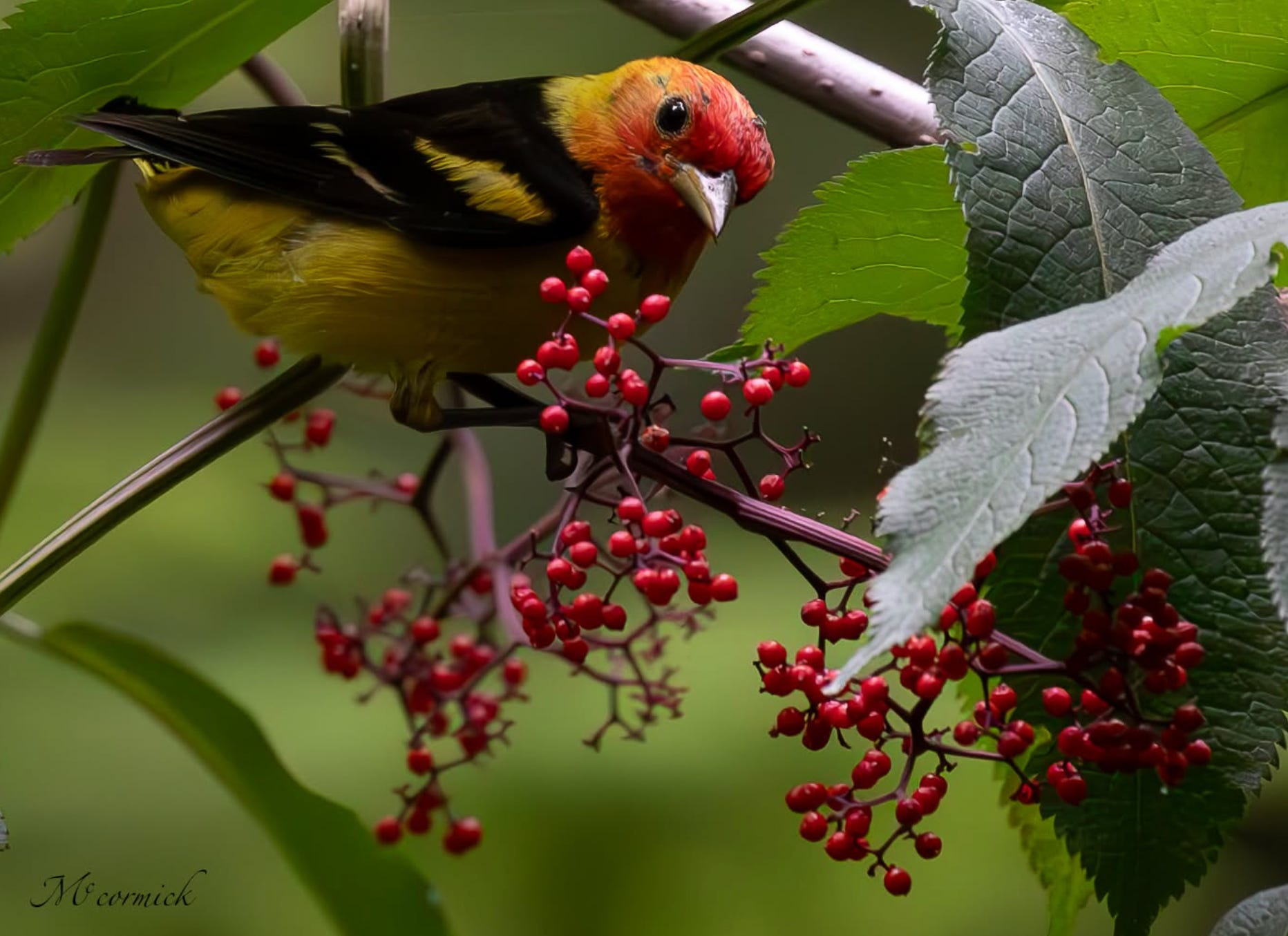
While I’ve not become an obsessed lister I do maintain a passing interest in identifying and keeping track of memorable bird sightings. I have used the iNaturalist app since 2017 to record a host of things observed. Recently I started using a bird song identification app called Merlin (which is connected to eBird, a bird logging app).
Things have changed since the pen and paper notebooks of my grandmother’s birding (and my own early childhood lists). As a child I had a modest collection of bird checklists produced by parks, communities, and various nature clubs. I kept field notes of a sort in an array of notebooks and journals. I maintained a single hand written list of all the birds I had seen up until my late teens.
Today’s birder is more likely to use a cell phone or tablet and a suite of digital apps then they are pen and paper.
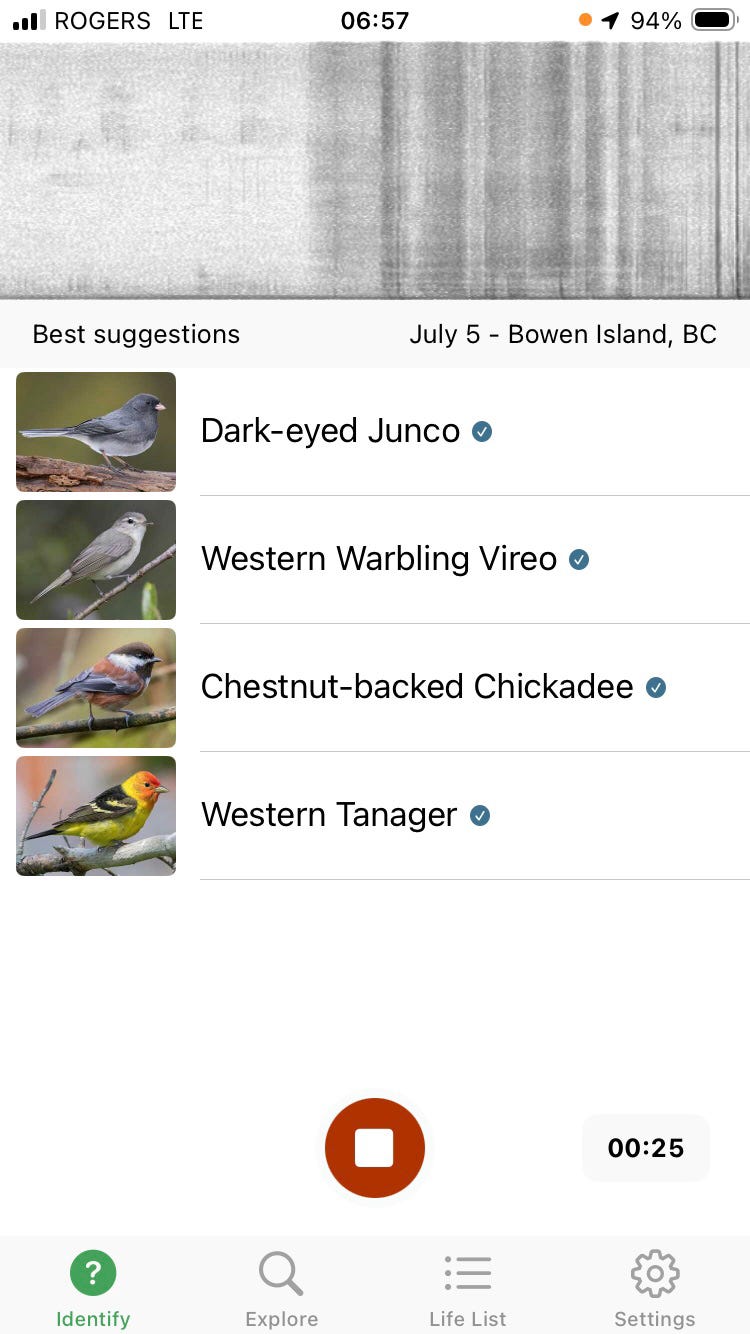
Merlin uses the onboard phone mic to record bird songs. The underlying software compares the sound with known recordings and suggests birds. Since starting to use the app in late May I’ve accumulated 47 birds on my Merlin life list. It’s fun, but I can’t help feeling I am some how cheating, just a little bit. When I think back on it it was only the more experienced and knowledgable birders in my grandmother’s circle who could flawlessly ID a bird by it’s song alone.
This got me to wondering about organized opportunities for campus bird watching. I cast my gaze about and came to rest on the AMS’s UBC Birding Club.
The UBC Birding Club
The UBC Birding Club has been on campus for over a decade. It is constituted under the AMS as a student club, though faculty, staff, and community members are also welcome. The club runs bi-weekly bird walks during the school year.
I met Vera Parco, club treasurer, at the UNA’s Old Barn Children's Garden in early July. Vera had just completed her BSc in organic chemistry and is starting a PhD in same here at UBC in the fall. She has been a member of the Birding Club almost since the start of her UBC studies.
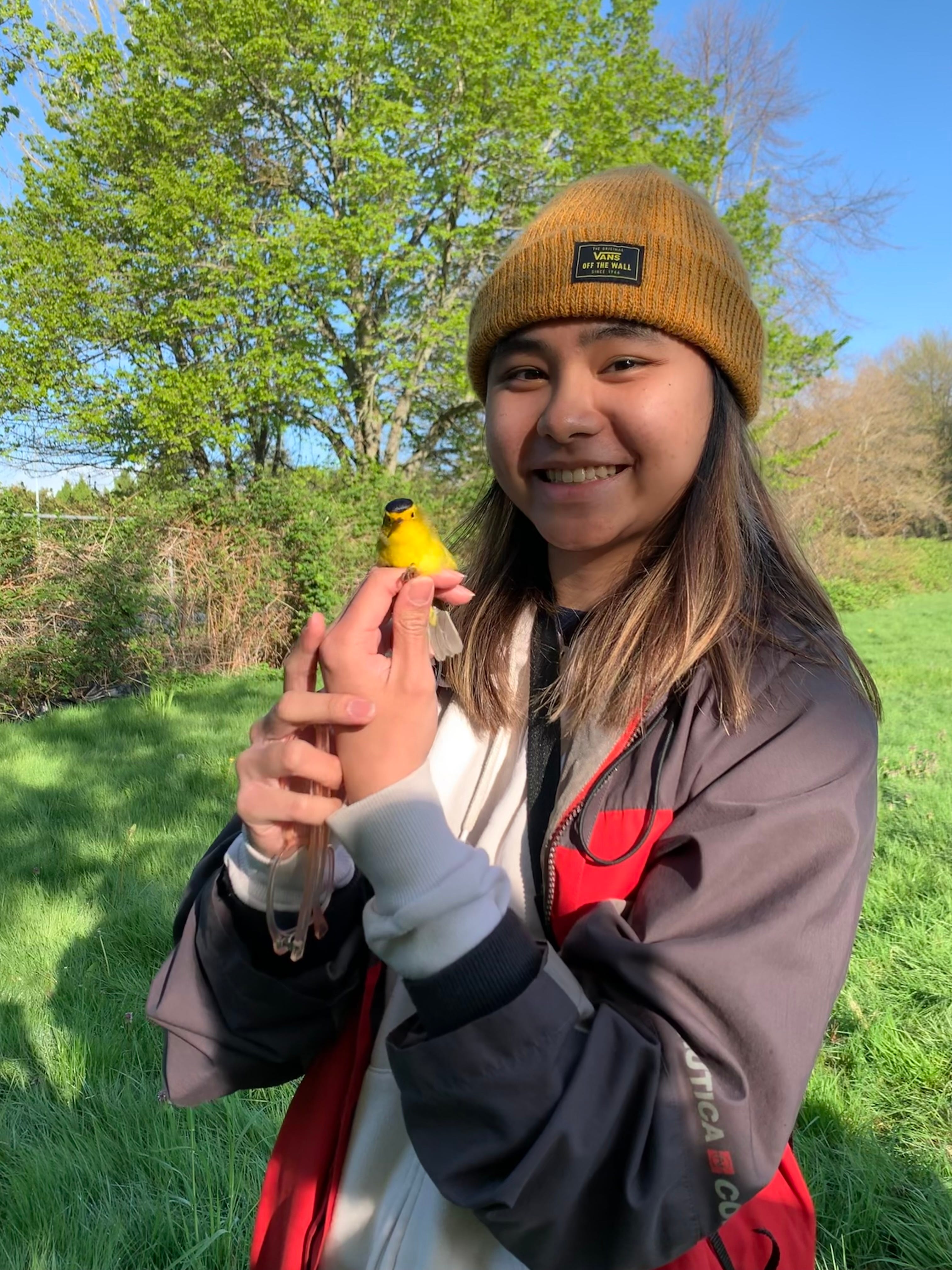
I asked Vera how she became interested in birding.
I’m an international student from the Philippines. In the Philippines, it’s probably like one of the best countries in the world to bird watch. So I’ve always known about bird watching because my dad and my brother, they would go bird watching, not really as a hobby, but more of like a fun thing to do when they’re in a new island or something. I’ve always known about birdwatching and we’ve always had binoculars [at home]. But when I came to Vancouver, I wanted to do research and so I joined this organization called REX ( Research Experience).
I was looking at the list of possible projects that I could join or apply to join. And of course, as a first year, I was kind of like, oh, I don’t know anything about DNA, like they’re never going to choose me for these projects. … Since I was already interested in ecology, I saw this one about birds and I applied to that. I was super grateful that I was chosen to be one of the members of that research team. I was paired with a grad student who was studying ornithology at the time. … It was really interesting to me and the graduate student was like, you know what, I’ll take you guys birdwatching. I was like, okay, why not? Like I’m free on a Saturday. So we went to Jericho.
And that was my first time ever birdwatching properly, actually holding a pair of binoculars that fit my eyes, cuz the ones I had at home were like way too big for me. So I was birdwatching and then I was just really fascinated by how when you pay attention, suddenly like the world is so big. I feel like when I walk, I would always just be like ‘Oh, there’s a bird.’ But then when I actually intentionally went bird watching, suddenly it was like it’s all different kinds of birds and I could actually name them and I could hear something and connect that to a bird.
I really enjoyed that because I actually also really enjoyed Pokémon. That’s actually a really popular way to describe bird watching, especially for younger people. They’ll describe it as like Pokémon in real life. In the game you’re a Pokémon trainer and you’re finding all of these Pokémon in the wild. Then you make a list or you try to complete your list of Pokémon that you found. It’s the same thing when you’re bird watching, you go around and you you make a life list. Have you heard of like a life list? So same thing. A lot of people who, a lot of young people who go into birdwatching, they’re surprised by it. They’re like, oh, it’s actually very similar to Pokémon.
I asked Vera if she was a lister.
I stopped listing after like a year. I keep it in my head. … But a lot of people in the birding club, they actually are very good, very diligent eBird listers.
I suggested maybe that’s a good thing.
“There’s a memoir,” I said “by a man about his father who was, who was one of these sort of competitive bird listers in the top tier. He’d track down obscure birds and even charter a flight to some obscure location. He’d hear that there’s some rare bird somewhere that he didn’t have on his list and he’d actually fly out to it, spend money to track it down.”
I asked Vera what her most memorable bird was from her first UBC Birding walk. “Northern flicker,” she said without hesitation.
It was really, really far in the distance. At Jericho? It was really far, like on the left side, I guess, if you’re facing the beach. Then I remember using the binoculars and I was like, wait, there’s a bird over there. It’s like super far away. Then I was able to ID it. … I was maybe I should do this as a hobby. I remember that bird being the bird that really got me.
They’re really pretty. They’re actually really common, but then they don’t look like they’d be a really common bird. It’s always really cool to see one in the wild. When they fly, you see the red under the wing.
Our conversation shifted to apps like Merlin.
I use [Merlin] quite frequently. I quickly started using it as soon as I got into birdwatching. I know some people have been birdwatching way before the app, so for them maybe they have more of an opinion about it, but for me, it’s really been ingrained in my, like, workflow, I suppose, as a birdwatcher. It’s really helped me learn the calls, right? Because, you know, a bird book can only teach you so much, but then Merlin like is just really, really good at identifying calls.
Vera talked about the collective knowledge of fellow birders and the enjoyment of participating in club events.
It’s fun. It’s nice to go. That’s why I like going with the birdwatching club, because you get members who have just been birdwatching their whole lives and really go every weekend, go birdwatching every weekend. So they bring so much knowledge with them. It’s great to go with them. They’ll really share it with everybody in the group.
Birding can be a solitary and a collective activity. While there are some competitive aspects, birding exists within an overarching culture of collaboration. The delight of seeing the world come alive around us once we pause and watch can be infectious.
The only birds I had time to watch at UBC were the two crows on the north side of SUB who stole lunches for years. Maybe their relatives are still working that angle.
I've watched and IDd birds since working at a nature camp back in the 1970s. I'm not a life lister or serious birder (not a morning person, so that kind of disqualifies me), but I got Merlin about a year ago and I'm kind of obsessed. Great post!