
Meet David Eby
Lawyer, MLA, community resident, and Premiere in waiting.

Earlier this week (Oct. 18, 2022) David Eby and I sat down over zoom to talk about what motivated him, what drove him to care about those around him enough to first become an activist, then a lawyer, and then a politician. Eby, his life partner, and their two young children live in the University Neighbourhood Area. Eby has been the NDP MLA for Point Grey since defeating then Premiere Christy Clark in 2013 by about 1000 votes. He won by more than 50% of the popular vote in each successive election. Eby is currently the sole leadership candiate for the NDP’s top job. He will be the third Premier to hold the Point Grey riding. [Disclosure, I am not currently a member of the NDP.]
I’ve intersected with David over the years in a number of ways. In 2008 I had toyed with the idea of seeking a Vision Vancouver school board nomination. Through that process I came to know of David and his amazing work in Vancouver’s downtown eastside. When he became MLA in 2013 I was an elected member of the UNA’s Board of Directors and met him several times in that capacity. Then as fellow residents of the UNA I have many times passed him by, often saying a brief hello, as we live out lives in our shared community. He is a neighbour in our community as likely to be met out shopping for groceries as playing in the park with his family.
David’s political history has been well covered in a number of places. Here are three of the most interesting: VanMag (2010), Vancouver Sun (2019), U Waterloo (2010). Given the type of stories typically written about political figures, which focus on their political decisions and policies, I wanted to talk about other things. I also didn’t want to talk about his leadership bid as that is already being written about and dissected in so many other places. So I asked David to talk about what motivated him to get involved in activism as a youth and young adult, about what drove him to be an advocate for the marginalized, and what prompted him to ultimately take the leap into electoral politics.

A Teenage Activist
People who were (are) activists as teenagers impress me. It takes a kind of clarity and commitment that many of us focus in other directions at that age. Growing up as I did, in a 1970s working class industrial town (Prince Rupert), union activism was a strong presence then. Eby grew up in suburban southwestern Ontario where I suspect union influence was less obvious than in my own working class fisheries/pulp mill town. Though, the influence of Canada’s steel town, Hamilton, had to have some impact on the potential of unionism and politics in Eby’s youth.
I had noted some of the features on Eby suggested his political start was in animal rights activism. I asked him to tell me something about what brought him to animal rights as a basis of progressive politics.
“Yeah, I often talk about my path to organized politics, starting out of frustration with politicians and their response, in particular to the downtown eastside. But my interest in environmentalism and sustainability and entree to human rights was indeed through becoming a vegetarian when I was 16 in high school and thinking about where our food comes from and the impact that our food has on the world around us and the treatment of animals. I grew up in a really remarkable environment where I was encouraged by my parents to explore different issues and care about the world. And at the time there was a lot of concern about a marine park in St. Catherine's, Ontario, called Marineland, the treatment of animals, in particular marine mammals, killer whales that were performing animals at that park, and also animals and circuses, elephants that were performing animals and so on. So that was a significant interest of mine in high school, which morphed as I got older, into a broader concern about human rights as I was exposed to the fact that not everybody grew up in the suburbs of southwestern Ontario town with the same kinds of privileges I had. But it was definitely my entree.”
In Rob Shaw’s Eby feature he quotes David’s brother Matthew who “recalled how, as a teenager, his brother once invited him to the circus near their childhood home in Kitchener, Ont. — only for Matthew to discover the trip wasn’t to enjoy the rides, but to videotape the treatment of elephants and demand answers from circus officials.”
I referenced this quote in our conversation “I think they quote your brother saying you convinced him to go to a circus and it was to basically hand out leaflets. I thought that was kind of an amusing thing. But you're the oldest son, right?
“Yes,” said David. “The oldest of four.” We spoke about our similar experiences as eldest sons and then shifted to talk about his college journalism.
College Journalist
During his undergraduate days in English at the University of Waterloo, David spent some time as student journalist. I asked him to tell me a little bit about that experience. Having myself written briefly for The Peak in the mid-1980s I have always harboured a soft spot for college journalists.
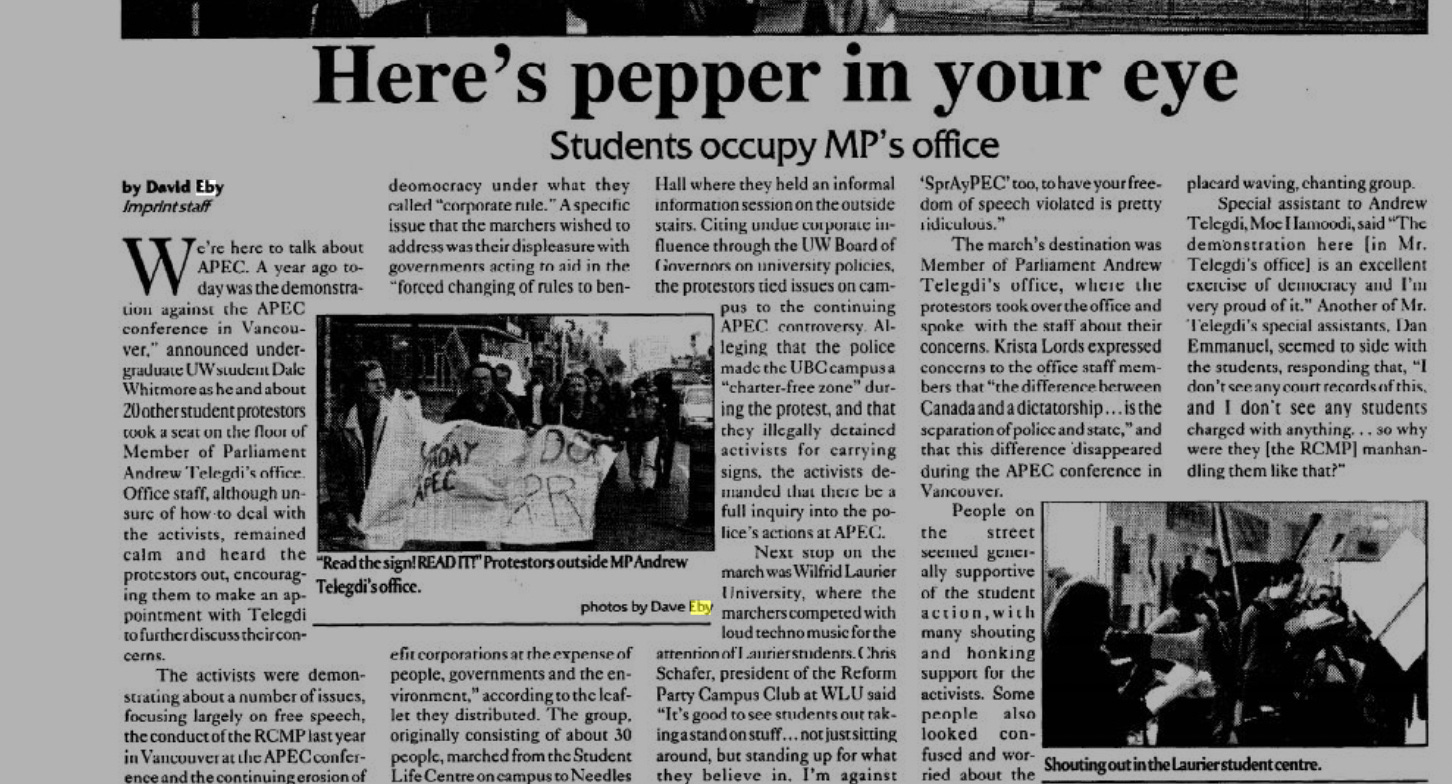
“My introduction to journalism,” David told me, “was, and journalism I use loosely, I served a summer term at the University of Waterloo paper as the arts editor. … I was very into music in my undergrad days, played music with my friends and was very into the local music scene and so wrote a lot of reviews of CDs and at the time, not something that you would write now. And was the arts editor for a summer. I applied unsuccessfully to be the editor in chief of the Imprint, but had a real interest in student life at the University of Waterloo when I was doing my undergrad.”
I commented that what few stories I could find that David had written from those days seemed to tilt about two thirds art/culture/music to one third political protest.
“Unsurprisingly,” said David, “I was very sympathetic to progressive causes in undergrad, a path of many NDP politicians.”
I asked if there were any stories in particular that really stuck in his mind from that period of time. I know there are some stories I recall writing from my days at The Peak, but when I did a search recently through the archives I was surprised to find I didn’t remember writing a lot of them, but wasn’t surprised by my focus (labour struggles, student politics, etc).
“No, not in undergrad, but in law school. I did a story about the grade curve at different law schools. It was fascinating to my colleagues in law school, anyone outside of law school, maybe less so, but there was a lot of concern and interest in grades, and I knew what my readers were interested in. … The trend was that the curves were remarkably different with no obvious pattern, and yet lawyers used grades to determine who the most appropriate students to hire were. And so the gap between employer expectations, potential employer expectations, but what your marks should be and the number of A's that any particular law school was handing out did not seem to correlate at all.”
The focus on procedural fairness that has marked Eby’s legal and political career was clearly evident in the grade curve story. I wanted to circle back to his undergraduate writing so pressed a bit further.
I had found a story that describe how he had been part of a zine called Art Riot. I asked David to talk about that experience.
“Oh my gosh, your research has been thorough. Yeah. So in the 90s, zines were like the place, and so we put together a little art magazine that had poetry and art, and I was hanging out with them. I went to the University of Waterloo, which was known as an engineering and math school, and I did English there. So I found common cause with the fine artists who went to the fine arts program at Waterloo. And yeah, that was very fun.”
Defending the Marginalized
A lot of Eby’s work prior to being an MLA has been with those pushed out of the mainstream society: with Pivot Legal Society and then with the BC Civil Liberties Association. I noted that a lot of his colleagues in the NDP have gone through the trade union route, as opposed to what one might call the human rights route. I suggested it’s a little bit different than the BC norm when you think of other BC Premier's, like Dan Miller (long time union business agent for Prince Rupert pulp workers union) or Glenn Clark (one time union organizers for the Ironworkers). Of course Dave Barrett was a social worker and Harcourt and Dosanjh were lawyers. Nonetheless, the labour movement path is a strong one in the NDP. I suggested that he might be coming from a different path and could he talk about how this might position him differently.
“So my interest in politics came from frustration with Vancouver City politicians in particular. I was working on the downtown east side. I actually went to law school not to form a basis to become a politician, but rather to hold politicians accountable. … When I actually was in the courts and trying to apply these laws that barely applied to my clients, certainly weren't written with them in mind, and it was quite torturous for them and for me.”
“I came into contact with city council … around the standards of maintenance bylaw. [This bylaw] allowed the city to go in and make repairs in these old SRO [single room occupancy] buildings to prevent them from being condemned and [then] bill the repairs to the landlords. … It was a bylaw actually, that had been won by Jenny Qwan and Libby Davies from the NDP, Mike Hartcourt as a street lawyer, and who am I missing? Ian Waddell. All of whom came from that kind of downtown east side lawyering, seemed they were all involved in achieving that bylaw, but the city wasn't using it.”
“I discovered it just out of work with people in the neighbourhood, like discovered in the sense that discovered it for myself as a tool that we could use. So I went to city hall with a bunch of activists and we were pushing for them to use that bylaw and the city just wouldn't use it. And that's what caused me to run the first time, in … the 2008 Vision Vancouver run, and I lost the nomination race. It was about three or four months of work. But Vision Vancouver ended up adopting a bunch of the housing proposals I put forward, including using that bylaw. I realized that in three or four months I'd had way more impact for my clients. It wasn't perfect, but I'd had way more impact for my clients than I had in the courtroom. I thought oh and that's surprising. Another discovery for me, politics can be a powerful tool for change and something that I hadn't really considered.”
“So it was actually a bylaw brought in by previous NDP premier and MLAs and MPs that inspired me to go to city council in the first place. I didn't even realize it at the time but that path of coming up through advocating with people who are on the edges is a well worn one and a proud history in the NDP and it's certainly one I'm proud of. And the labor movement has many similar goals with just a different method of achieving them [through] organizing people’s workplaces. I think that’s why we have so much in common … in this Big Tent NDP party because we share so many goals around human rights and not leaving people behind and looking after each other and providing that support.”
David’s response to me was to highlight the care and concern with redressing wrongdoing that both trade unionism and human rights activism focus on.
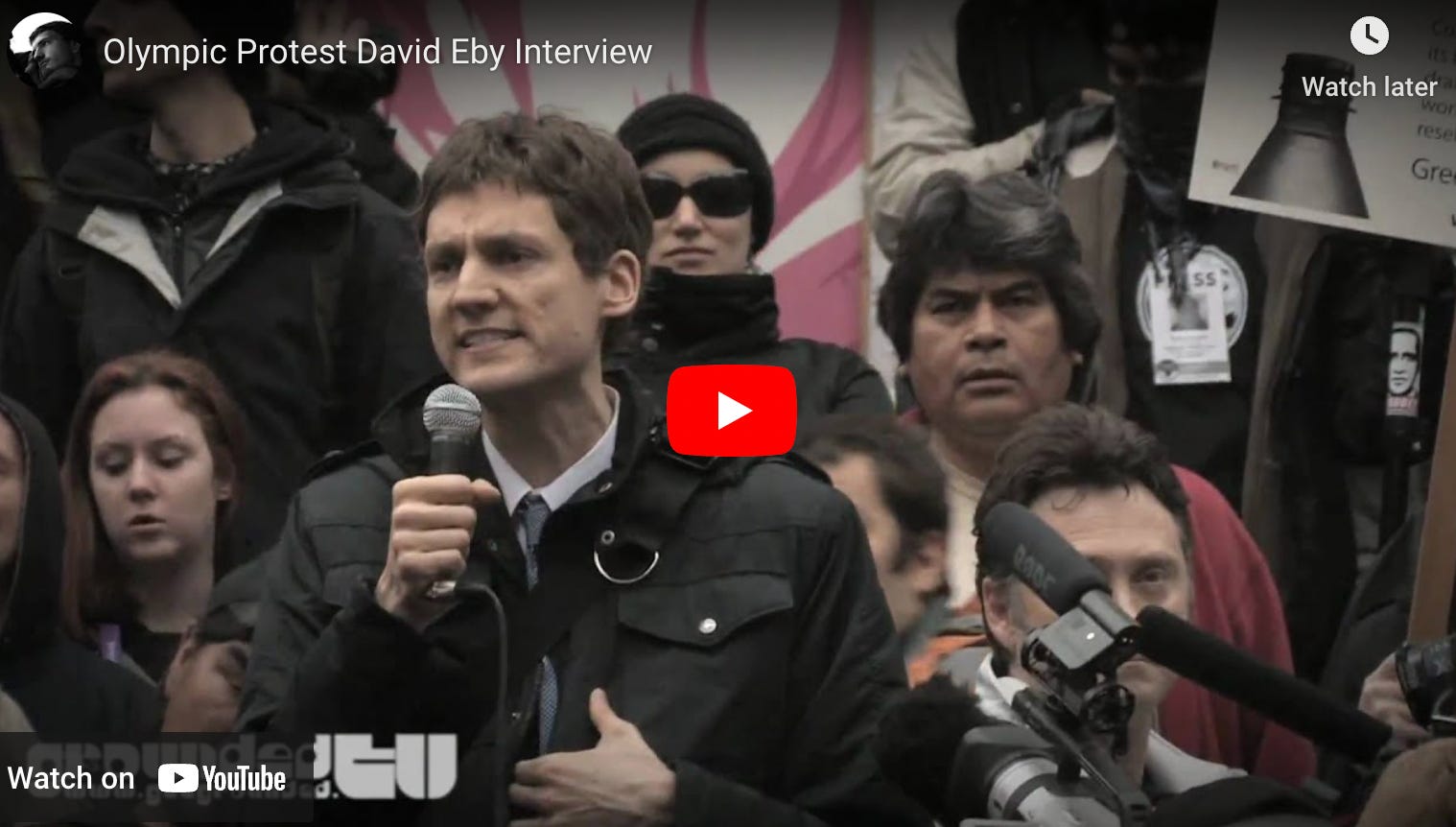
David mentioned that it was frustration with city politicians that brought him to electoral politics so I asked him about his failed 2008 attempt for a Vision Vancouver nomination for city council candidate. “Do you think maybe it was a good thing you didn't get the vision nod at that point in time,” I asked him.
“It's hard to get perspective when you lose an election. But ultimately it was a good thing for me because instead of sitting in City Council, I had the opportunity to run in 2011 against Christie Clarke in the by election, which was my introduction to provincial politics and to the Vancouver Point Grey constituency. So things worked out okay.”
We left politics and activism there.
Family Influences
In my own work and writing I consider the implications of my parents on my thinking, of how their influence shaped my own sense of self and guided my interactions in life. I've done research looking into this. I've interviewed my father many times. I've got a whole mini library of books by sons writing about their fathers which then expanded to daughters writing about their fathers and more. I spent a lot of time with my own father, he's 93, a retired commercial fisherman. He and I spent many hours together on his fishing boat. So I asked David to reflect upon himself, in this moment in time, with his own father, his own children, how does he see this shaping his thoughts about the world in which we are operating, what drives or gives him pause about his own actions?
“There were a bunch of things about my parents that set me up really well for life and for being a parent. I'm incredibly grateful that I was fortunate in this way of growing up in the house that I did. My dad was a lawyer, a personal injury lawyer, which was made the ICBC stuff significantly more challenging at a personal level. Just knowing that my own father had a personal injury practice in Ontario when the NDP did a half reform of the car insurance system there. But it decimated his practice at the time. Remembering that being challenging for our family. My mom went back to work as a teacher to make sure that we could get through okay. Knowing that essentially as Attorney General, I was doing the same thing around the ICBC reforms to many people who worked in that industry associated with car insurance in our province. In that way, it made me more empathetic to the concerns of those individuals and families working in that sector and more sensitive to the realities that they faced. But the advantages and politics that my parents conveyed were encouraging me to be open minded, to challenge accepted beliefs, and to be willing to speak out about issues of concern.”
“My mom was a teacher and a principal, so it was like having my own school at home with her. So I had great support from my parents and have all the way through. And so for my kids, the piece that I worry about is when I think about my own growing up, is we were the center and we were very much the focus of our parents. And this job that I'm applying for currently for Premier is going to challenge that time balance with my family and that ability to offer the same thing to my kids. [It] also runs the risk of exposing them to scrutiny and comments and problems at school and everything else. If I have to make decisions that their colleagues’ parents are unhappy with -and they don't get to choose that. I'm choosing that for our family, with my partner, with my wife. And so this is something that I worry about and I'm feeling really grateful that I had growing up and something that, if I'm successful in this leadership, is something that will have impacts on my kids, both positive and negative. They've done things that are already at their young ages that they have access to because of my job, but they'll also suffer the downsides as well.”
It struck me as remarkably empathetic for him to frame it this way. It's hard, as a parent, to sometimes see this in the moment and think about the effects our action might have, actions which we often can't actually control. It reminded me of the line from the prose poet Elizabeth Smart1 “Parents’ imaginations build frameworks out of their own hopes and regrets into which children seldom grow, but instead, contrary as trees, lean sideways out of the architecture, blown by a fatal wind their parents never envisaged.”
Leadership
As of Wednesday past (Oct. 19, 2022) the BC NDP council made a decision that means David Eby is the sole candidate for the leadership of the party and thus, the next Premier of BC. Even though none of our conversation was about David’s leadership bid, and it was the last thing I was interested in talking about, it was nevertheless a large shadow in the background. Listening to a person who speaks with care, insight, and empathy as David does can tell us a lot about a person’s qualities. It matters little whether we agree on the issues, instead I have seen time and again that Eby is a man of honour, reliability, hardwork, care, and passion. He strives to make our world a better place, not just for the already entitled, but especially for the forgotten, the ignored, and the silent. Meet David Eby, neighbour, community member, and next Premier of BC.
Elizabeth Smart, I Sat Down by Grand Central Station and Wept, 1945.