
Forest Walks
Learning about trees with research librarian Ryan Regier

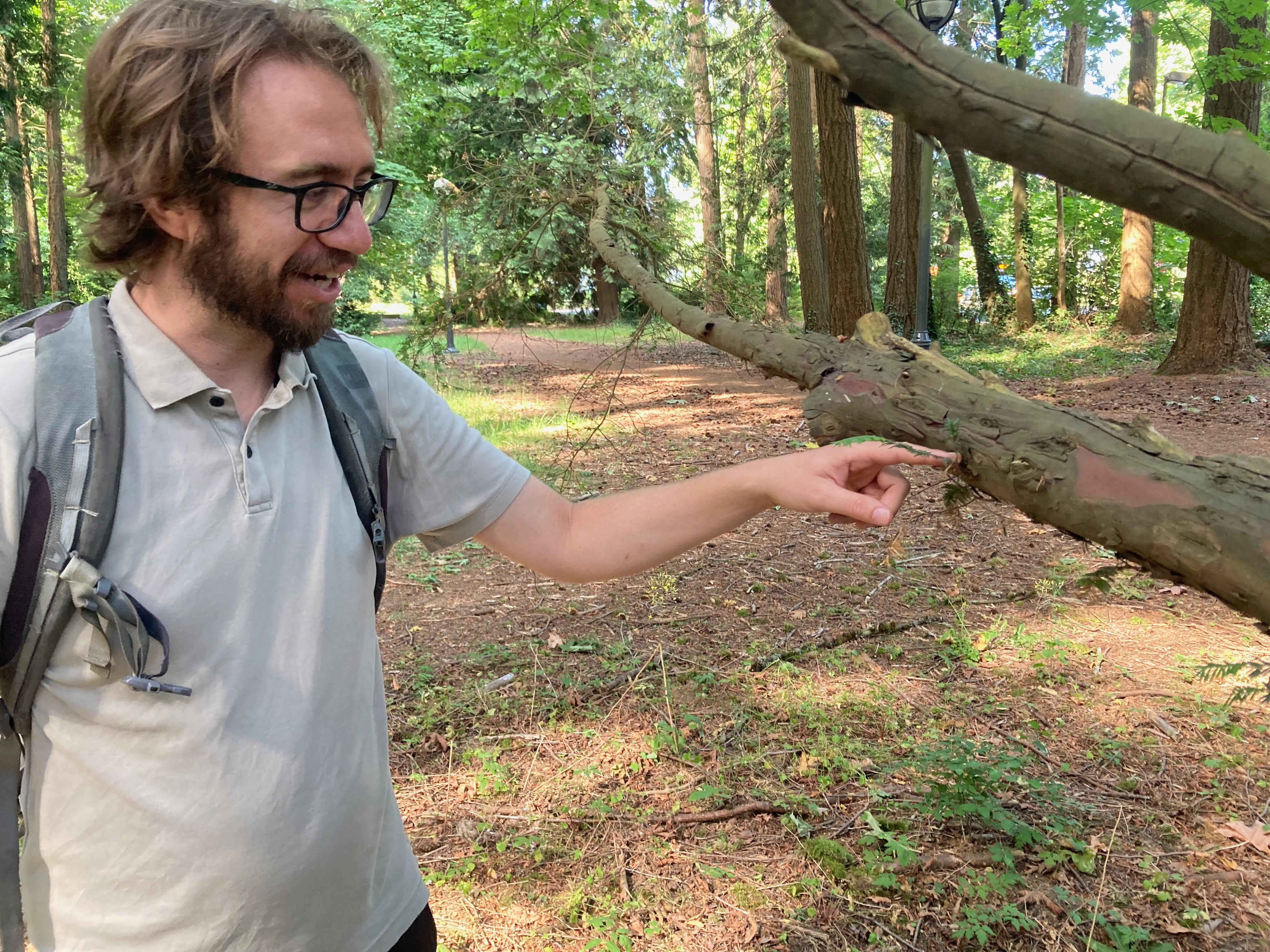
Ryan Regier and I met late June in the small grove of trees adjoining Totem Park to the north. I learned about Ryan through a series of blogposts he had written for the Pacific Spirit Park Society. From there I saw he was a campus colleague in the library who, in his spare time, led free forest walks.
This is part of a series of stories inspired by the environment UBC is situated within. From birding to mosquitos, eagles, and rewilding, A Campus Resident has explored the ‘natural’ world around us. UBC’s built environment is embedded within a large urban forest. This story brings us into the forests we live within.
The house I grew up in backed onto a forested ravine. Along the bottom of which ran a creek. There was also a large sewer pipe running alongside the creek that many folks used as a convenient trail. Most houses in Prince Rupert were small, built on tiny working class lots that made it difficult to constrain children. With the forest behind our house we had an entire other world to play in. Children up and down our street roamed the trails in the ravine. We picked huckleberries, built tree houses, and visited our friends. We did this all through the informal forest parkland behind our homes. We had the freedom to play and a sense of security within which to enjoy our freedom.
The urban forests and tree patches in and around UBC provide a facsimile of the wilder forests of my childhood. Children rarely linger in these UBC forests without some kind of adult observation. It’s not that these forests are completely isolated or secluded. Rather, the effects of other people are strongly felt. This urban sensibility at times lends a foreboding air to UBC’s forest patches. A UBC/UNA perception of safety study had this conclusion on forested lands:
For residents, the feeling of safety near forested areas on campus was addressed frequently in different ways. While some mentioned feeling safe in natural surroundings, it appears to create uncomfortable feelings for others, often related to the lack of lighting. This supports the finding from Burden et al. (2013) regarding negative feelings of safety around forested areas on campus. The lack of familiarity might also be a factor in the level of comfort experienced by residents (Perceptions of Safety, 2014).
Ryan highlights building familiarity with forests through the experience of walking and learning in forests.
In the Forest
In the treed patch Ryan and I met, the birds sang against a background of heavy truck traffic, the digging of excavators, safety beeps of backing vehicles, police sirens - a constant rumble of city sounds. We were witness to a steady flow of people walking through the grove and down the nearby roads and sidewalks. Midway through our conversation a group of children from a nearby daycare were shepherded into the grove for a guarded play session.
At the same time, the forest patch created a kind of oasis for our conversation about trees, nature, and our place within it all.
Ryan told me said:
I’ve been leading forest walks around the city for multiple years. I work at Woodward Library, I was looking for a forest to lead walks for library staff and UBC staff. … I was trying to find a good patch of forest to lead a walk in. This patch of forest is actually incredible because it has most of the forest diversity here, where you get cedar, you get hemlock, you get yew, you get Douglas fir, and there’s actually a couple big grand firs. Then you also have some big leaf maple, and it’s, it’s really good. This is the perfect spot to come to teach people the native trees, and they’re all in one nice area. So I came here, I was walking around here, and I was a bit stunned by this yew because it’s such a good example of Pacific yew.
Ryan and I had a wide ranging conversation that touched on climate change, urban forests, ancient trees, culturally modified trees, ravens, history, philosophy - the list continues. From our conversation I have highlighted the story of how Ryan started his free forest walks and our discussion of pacific yew trees.
Ryan explained how he came to guide forest walks.
I wanted to study forest science and trees for a long time, but I struggle with the objectivity science requires. I love stories. So I went to library school. That was great because it taught me how to research and teach myself. For a long time I had a library blog where I’d write about stuff in libraries. … I’ve spent a lot of my time in libraries advocating for open access. … As open access started to make some movement, I quickly realized that it’s not open information that’s the problem. Understanding information is the problem.
I got to thinking ‘what is something I can do with environmental education?’ We were having a bit of a moment around 2018. There was The Overstory by Richard Powers. I read that and that got me really interested in trees. The thing I’ve always loved about trees is that they’re so much older than us, and they have these myths and lore attached to them. … I think a lot of our, a lot of our folk tales, fairy tales, sense of magic come from trees. Susan Simard often talks about trying to humanize trees, but I think trees are very much like aliens, but, you know, ancient aliens. If we came to another planet, we found aliens, they would look something like trees. So talking about this, it’s not just the science of trees that fascinates me, it’s the lore behind them and the mystery.
I asked Ryan if he had a favourite walk.
Do I have a favourite walk? It’s a good question. My yew walk in Pacific Spirit Park, that’s quite a good one that I really like. People come on that one. I’ve been switching them up quite a bit I think. One thing with my walks, I like to do them on what I am currently obsessed or interested in. So I don’t know if I currently have a favourite walk. Lately I’ve been doing a lot of little loops of the Jericho Park Forest, which I’m kind of fascinated by because it has so many invasive species. So I think that would be on there. Just the other day I took a friend on there and there’s a family of barred owls there. They have 3 teenaged barred owls. These owls are so close. They’ll land on a branch, like you can almost reach up and touch them. They’ll look right at you. They’re doing this thing where they like they move their head and it looks just like a child, like, you know, children kind of learning the extent of their bodies. It’s stuff like that. Where we have these incredible natural areas you can go to and it’s because the trees that are there.
Pacific Yew
We focussed a lot of our conversation on yew trees.
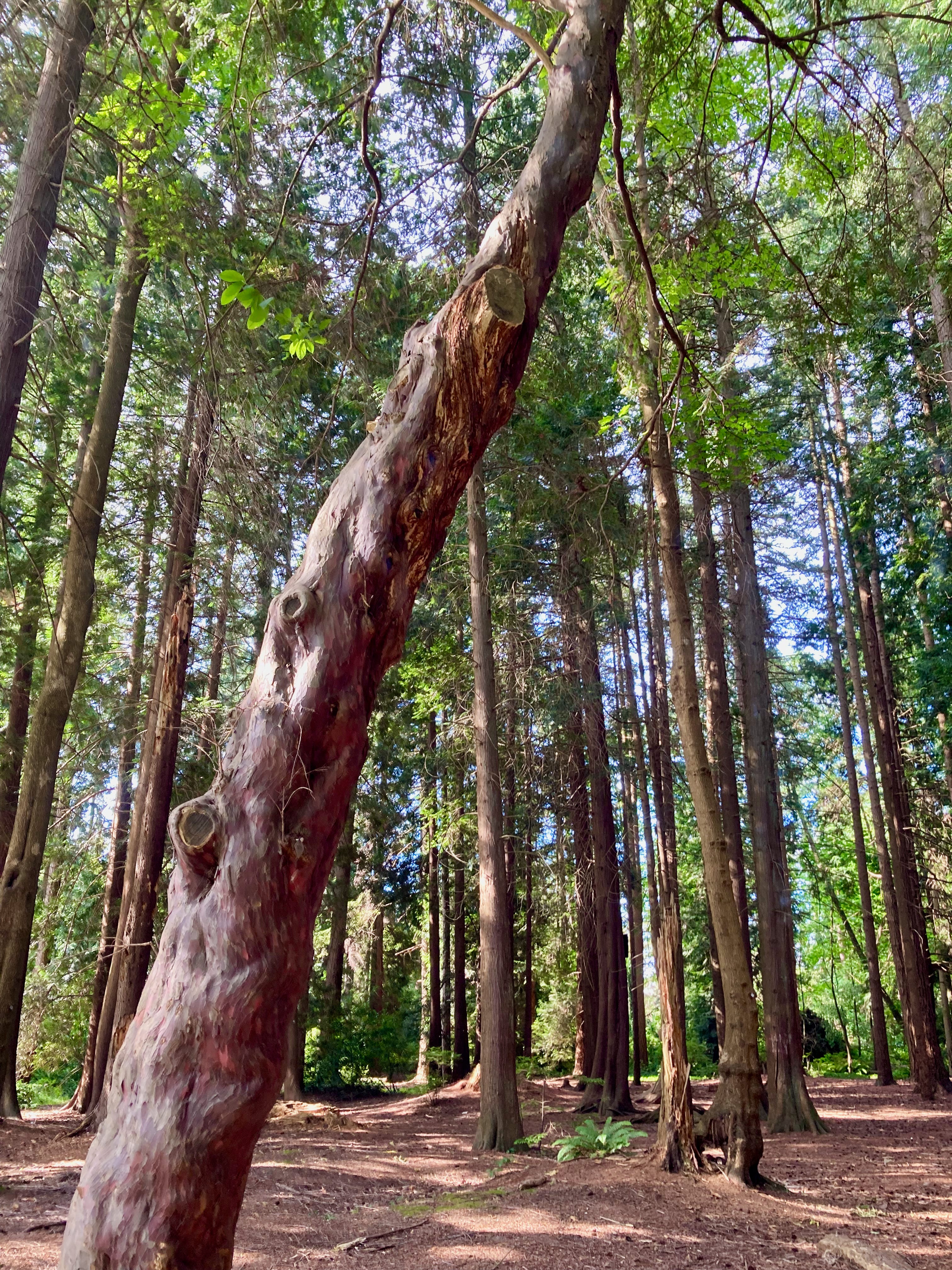
Ryan told me there were two yew trees in this forest patch.
There’s this one [that we were standing in front of] and there’s the one over there [he pointed away from us]. I can show you. So this is one of the things with yew, it’s, it’s very much a tree that depends on older forests. Often you don’t see it in new areas.
This yew is doing quite fine. One of the stories you often hear about yews is, these giant ancient yews in graveyards and churchyards in Europe. It’s a common thing in an old churchyard or graveyard to find these giant yews, and a lot of these yews are so big that they’ve actually rotted in the middle. They’ve kind of spread out, the middle’s rotted, and sometimes they’ve actually broke apart, so like one yew has become many separate trunks. There’s a lot of dispute over these yews because some people argue these yews might be some of the oldest trees in the world. It’s believed that maybe they were ancient pagan worship sites. When the Christians came in, they commandeered stuff like they did the Christmas tree and they made a church there.
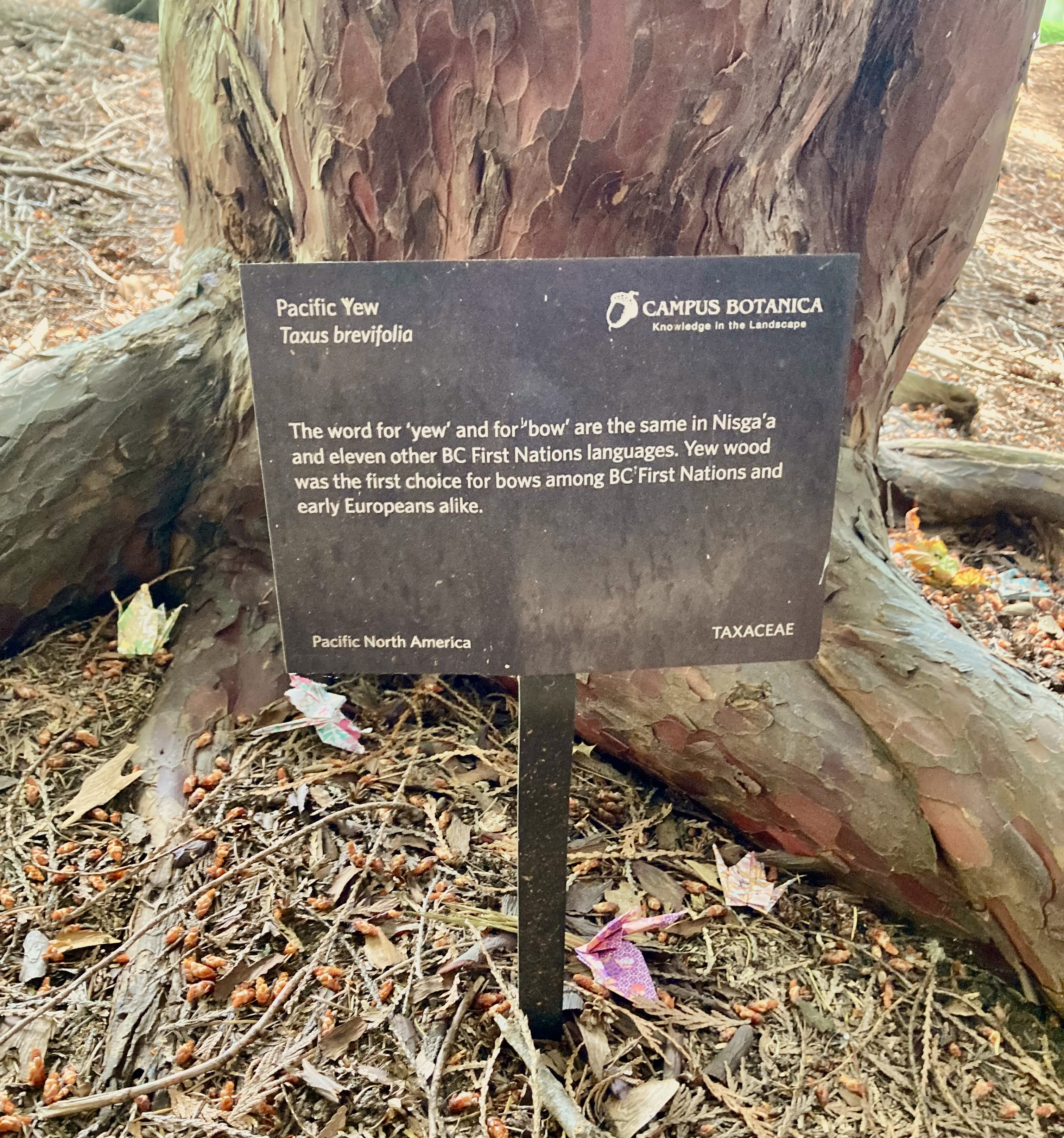
At this point I mentioned we were in fact standing very close to a former Musqueam village site. Prior to the deadly impact of colonial era diseases there had been a much larger Indigenous population on Point Grey and they maintained a goodly number of villages beyond the modern Musqueam town site. Our conversation turned toward the Campus Botanica sign that noted the Nisga’a word for yew tree was the same as their word for bow.1

This fact about yews being bows always fascinates me, Ryan said.
“I have pictures from the Museum of Natural History in New York of yew bows from the north coast of BC,” I replied.
The bow thing is fascinating, said Ryan. 'cause on both continents they used it for bows.
Another thing, the thing I love about yew, and this mostly happens in Europe, is whenever we find an Iceman or a bog body, almost always all their tools are yew. They have yew staff, yew bows, even the handles for the daggers. Indigenous people here would use yew because the wood is so hard, they would use it for wedges. So essentially like the metal parts of axes.
At one point in our conversation the group of children inundated us as they mobbed a huckleberry bush. They pointed out the berries and encouraged us to pick some as well. We wandered away from the children and inspected some nearby cedar trees to see if they showed any evidence of having bark peeled off them for weaving.
Ryan’s forest walks are filled with enticing detail and wisdom. I found our knowledges different, but complementary. I grew up in a north coast rainforest and have spent much of my adult life researching and writing about people who make their lives living and working in the natural environment. Ryan’s forest walks (see here) open doors of understanding for urban folk who want to better appreciate one small part of our shared world.
For reference, the Tsimshian word (linguistically close to Nisga’a) for yew also has as its root a word that means weapon or bow. sahakwdak [sa/*hakw/dak]. Stem with modifying proclitic composed of: sa=2 do/make/get, hakwdak bow (weapon) [from Smalgyax Living Legacy Talking Dictionary].
This is wonderful. I wish I was still in town so I could join a walk.
We interrupt this post about trees to bring you BERRIES OM NOM NOMM